The following information are highlights from Environmental Health Officer, Jack Mallard’s presentation at the 2018 ARCH Annual Meeting
Hand washing
Hand washing is very important, yet it is not done enough or is done incorrectly. Here are the steps for proper hand washing:
- Wet hands with warm water.
- Apply liquid soap.
- Scrub hands together for at least 20 seconds, washing the front and back of your hands and between fingers.
- Rinse hands with warm water.
- Dry hands with paper towel.
- Turn the tap off with the paper towel.
As explained by Mallard, soap creates friction between the skin and dirt, which makes it easier to remove. Without soap, the dirt will stick to your hands. He also suggested having the garbage can close to the door of the washroom because people will use paper towel to open the door. By placing the garbage can close to the door, it is easier for people to throw it out.
Hand washing should be done very frequently. Here are some times that you must wash your hands after:
- Sneezing or coughing
- Touching a dirty surface or leaving the garbage area
- Eating, drinking, or smoking
- Engaging in any work
- Touching any part of the body
- Handling raw food and prior to touching ready-to-eat food
- Using the washroom
Always remember that you can never wash your hands too much in the kitchen! Also, hand sanitizer is not a replacement for proper hand washing.
Food protection
If you plan on selling food to the public, all food must be prepared in a licensed kitchen. If your hall kitchen isn’t licensed, you can apply for a license through Health and Wellness PEI. Your kitchen must be inspected at least once per year. Here are some tips to keep your food safe:
- The “danger zone” is between 4°C and 60°C. Any temperature within this range is the prime temperature for bacteria growth, which can cause spoiling. Always remember to keep hot food hot and cold food cold.
- Hot food must be maintained at least 60°C. When reheating food, heat it to 74°C.
- Only reheat food once.
- Cold foods must be stored in a fridge between 0°C and 4°C or in a freezer at -18°C.
- Keep working thermometers in all fridges and freezers.
- Fresh produce and other ready-to-eat food must be prepared and stored separately from raw products.
- Label all cooked, cooled, and prepared food with date, time, and the name of the person who prepared it.
Thawing frozen food can be dangerous. Here are some safe thawing methods:
- Thaw in the refrigerator. Raw meat should be thawed in a container on the bottom shelf.
- Under cold running water, do not leave in a container with cool water.
- In a microwave oven if it will be cooked immediately.
Never leave food out to thaw. This leaves them in the “danger zone”. Take a look here: Temperatures and Food Safety.
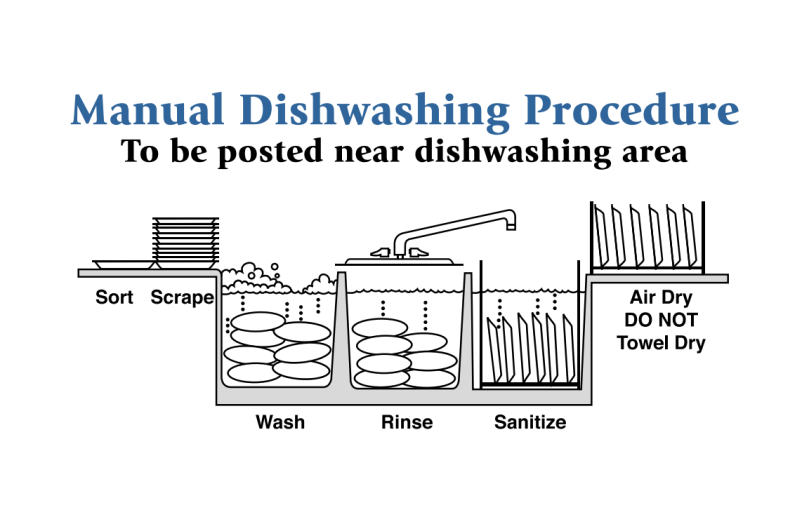
Dishwashing
Food safety courses
Every licensed kitchen must have at least one person who has passed the food safety course and is certified. You can find a list of approved food safety training programs here:
There is also a Volunteer Food Safety Course which establishments such as churches or community halls can host for their volunteers. This required food safety seminar is a free three-hour presentation on proper food handling, preparation, and service practices. This course is offered twice a year, in the fall and spring:
Please note that the Approved Safety Training Programs list also has a link to an online Volunteer Food Safety Training Course.
This PDF covers all of the important points of the Volunteer Food Safety course:
A good rule of thumb when it comes to food safety is “when in doubt, throw it out”. If you have any suggestions for this page, you can email us at peihalls@gmail.com.